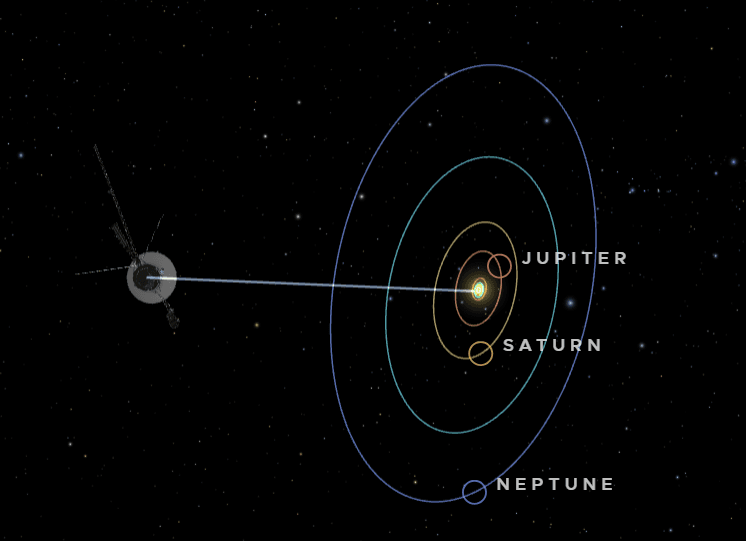
Humanity has achieved another remarkable milestone in space exploration. NASA's Voyager 1 spacecraft, which has been travelling through space for nearly five decades, has reached a distance of one light-day from Earth. This means the spacecraft is now so far away that even a signal travelling at the speed of light takes approximately 24 hours to reach it.
Voyager 1 achieved this historic milestone on November 18, 2026, becoming the first human-made object to reach this distance from our planet. Launched in 1977, the spacecraft has travelled farther than any other human-made object and continues to help scientists understand the mysterious region beyond our solar system.
The achievement is more than just a distance record. It highlights how far human curiosity and engineering can take us, even when a mission lasts much longer than the careers of the people who originally designed it.
In this article, we explore what one light-day means, how Voyager 1 reached this point, why the milestone matters, and what could happen to the spacecraft in the coming years.
What Does One Light-Day From Earth Mean?
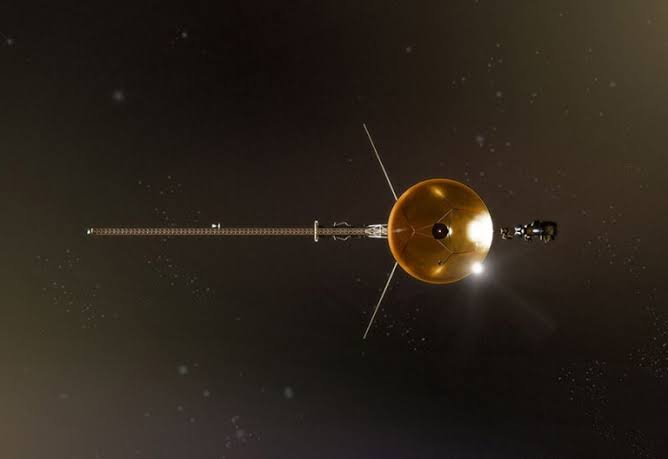
A light-day is the distance that light travels through space in 24 hours. Since light moves at approximately 299,792 kilometres per second, it can cover an enormous distance in a single day.
One light-day is approximately:
16.1 billion miles
25.9 billion kilometres
The distance light travels in 24 hours
To understand how far this is, consider that sunlight takes around eight minutes and 20 seconds to reach Earth. A radio signal travelling from Voyager 1 now needs approximately 24 hours to reach our planet.
This does not mean Voyager 1 has suddenly slowed down or changed its journey. It simply means the spacecraft has travelled far enough that communication takes an entire day in one direction.
If scientists send a command from Earth, it takes about 24 hours to reach the spacecraft. A response travelling back to Earth takes another 24 hours. Therefore, a simple communication exchange can take roughly two days.
This is one of the clearest examples of how enormous distances in space can affect even the most advanced technology.
When Did Voyager 1 Reach One Light-Day?
According to NASA, Voyager 1 reached the one-light-day milestone on November 18, 2026, at approximately 2:16 a.m. Pacific Standard Time.
The spacecraft was about 16.1 billion miles (25.9 billion kilometres) away from Earth at that moment. NASA confirmed the achievement after analysing the spacecraft's signal and its calculated trajectory.
Voyager 1 has been travelling through space since September 5, 1977. That means it took more than 49 years to reach this extraordinary distance.
The milestone is particularly meaningful because no other human-made spacecraft has travelled this far from Earth.
Although Voyager 1 is now extremely distant, it remains an important part of NASA's scientific exploration programme. Its journey continues to provide valuable information about the environment beyond the Sun's influence.
How Did Voyager 1 Travel So Far?
Voyager 1 was launched by NASA in 1977 as part of a mission to explore the outer planets of our solar system. The mission took advantage of a rare planetary alignment that allowed the spacecraft to visit multiple planets using gravitational assistance.
During its journey, Voyager 1 studied two major planets:
1. Jupiter
Voyager 1 reached Jupiter in 1979 and provided detailed observations of the giant planet and its moons.
One of its important discoveries involved Io, Jupiter's volcanic moon. The spacecraft observed active volcanoes, revealing that volcanic activity also occurs beyond Earth.
It also captured valuable images of Jupiter's atmosphere, rings, and other features.
2. Saturn
In 1980, Voyager 1 flew past Saturn and studied its complex ring system, atmosphere, and moons.
One of its most important observations involved Saturn's moon Titan. The spacecraft gathered information about its thick atmosphere, helping scientists understand why the moon deserved further exploration.
After completing its Saturn encounter, Voyager 1 followed a path that sent it away from the major planets and toward interstellar space.
Its journey eventually became one of the longest-running and most successful missions in the history of space exploration.
Voyager 1 Entered Interstellar Space in 2012
Another major milestone occurred in August 2012, when Voyager 1 became the first spacecraft to enter interstellar space.
Interstellar space is the region beyond the heliosphere, a large protective bubble created by the Sun's solar wind and magnetic field.
The heliosphere helps shield the solar system from some of the energetic particles travelling through the galaxy. By crossing its outer boundary, Voyager 1 entered a region where the influence of the Sun is much weaker.
This gave scientists an opportunity to study an environment that had never been directly explored by a spacecraft before.
Voyager 2 followed a different route and entered interstellar space in November 2018.
Both spacecraft continue to provide unique observations of the region beyond the heliosphere, making their mission important for understanding the space between stars.
Why Is the One Light-Day Milestone Important?
Reaching one light-day from Earth is a significant achievement for several reasons. It demonstrates the extraordinary distance a human-made spacecraft can travel and shows how communication becomes more difficult as spacecraft move deeper into space.
Here are some of the major reasons this milestone matters.
1. A New Record in Human Space Exploration
Voyager 1 has become the first human-made object to travel one light-day away from Earth.
This achievement represents nearly 50 years of continuous movement through space. It also reflects the dedication of generations of engineers, scientists, and mission specialists who have kept the spacecraft operating long after its original mission.
2. Communication Takes Much Longer
When Voyager 1 was closer to Earth, radio signals could travel between the spacecraft and mission control in a much shorter period.
Now, a signal needs approximately one full day to travel in either direction.
This creates challenges for engineers because they cannot communicate with the spacecraft in real time. Every instruction and response requires patience and careful planning.
3. Scientists Can Study Interstellar Space
Voyager 1 continues to offer a rare opportunity to study the environment outside the heliosphere.
Its observations help scientists investigate magnetic fields, charged particles, and other conditions in interstellar space.
Since very few spacecraft have travelled this far, the information collected by the Voyager mission is especially valuable.
4. It Demonstrates the Power of Long-Term Engineering
Voyager 1 was designed in the 1970s, when computer technology and spacecraft engineering were very different from what we use today.
Keeping it operational for nearly 50 years has required creative solutions, careful energy management, and constant problem-solving.
The mission shows that well-designed technology can continue delivering scientific value for decades.
Is Voyager 1 Still Sending Data to Earth?
Voyager 1 is still in contact with Earth, but its ageing technology is creating challenges.
NASA reported in November 2026 that the spacecraft stopped sending science and engineering data on November 14. However, its carrier signal was still being detected by NASA's Deep Space Network.
A carrier signal indicates that the spacecraft is transmitting a signal, even though the expected science and engineering information is not currently being received.
Mission engineers are investigating the issue and working to understand what caused the interruption.
The spacecraft also faces another major challenge: its power supply is gradually decreasing.
Voyager 1 uses a radioisotope thermoelectric generator, which produces electricity from the heat released by decaying plutonium. As the plutonium supply decreases, the spacecraft loses approximately four watts of electrical power each year.
To extend the mission, NASA engineers have been switching off equipment and replacing some systems with lower-power alternatives.
These energy-saving decisions are important because they may help keep the remaining scientific instruments operating for longer.
What Is the Golden Record on Voyager 1?
One of the most fascinating parts of the Voyager mission is the Golden Record.
Voyager 1 and Voyager 2 each carry a gold-plated copper record containing sounds, music, images, and greetings from Earth.
The record was designed as a message to any intelligent civilisation that might discover the spacecraft in the distant future.
It includes different sounds from our planet, such as:
Natural sounds, including wind, rain, and thunder
Greetings in several human languages
Music from different cultures and periods
Images representing human life, science, and nature
Information about Earth and the human species
The Golden Record is not a communication device that allows aliens to contact Earth. Instead, it is a symbolic introduction to our planet and its inhabitants.
Even if Voyager 1 eventually stops communicating with NASA, the record will continue travelling through space.
It represents one of the most unusual ways humanity has attempted to introduce itself to the wider universe.
Voyager 1 and Voyager 2: What Is the Difference?
Voyager 1 and Voyager 2 were launched in 1977 as twin spacecraft, but they followed different paths through the solar system.
Feature | Voyager 1 | Voyager 2 |
|---|---|---|
Launch date | September 5, 1977 | August 20, 1977 |
Jupiter flyby | 1979 | 1979 |
Saturn flyby | 1980 | 1981 |
Uranus flyby | Not visited | 1986 |
Neptune flyby | Not visited | 1989 |
Entered interstellar space | 2012 | 2018 |
One light-day milestone | November 18, 2026 | Expected around November 2035 |
Voyager 1 travelled on a faster route away from the planets and became the first spacecraft to enter interstellar space.
Voyager 2 followed a different trajectory that allowed it to visit Jupiter, Saturn, Uranus, and Neptune. It remains the only spacecraft to have visited Uranus and Neptune up close.
Both missions have made important contributions to planetary science and our understanding of the space beyond the heliosphere.
What Happens Next to Voyager 1?
Voyager 1 will continue moving away from Earth, but its future depends on how long its remaining systems can operate.
The spacecraft's power supply is gradually declining, and NASA must carefully manage its limited electrical energy. Engineers are prioritising the systems that provide the most valuable scientific information.
Its communication challenges are also expected to increase as the distance grows. A signal will take longer to travel between Earth and the spacecraft with every passing year.
Eventually, Voyager 1 will no longer have enough power to operate its instruments and communicate with mission control.
However, its journey will not necessarily stop when communication ends. The spacecraft will continue travelling through interstellar space, carrying the Golden Record into the distant future.
NASA has also noted that Voyager 1 is heading in the general direction of the star Gliese 445. It is expected to pass within approximately 1.7 light-years of that star in around 40,000 years.
That is a reminder of just how slowly spacecraft move compared with the enormous distances between stars.
What Does This Achievement Mean for Future Space Exploration?
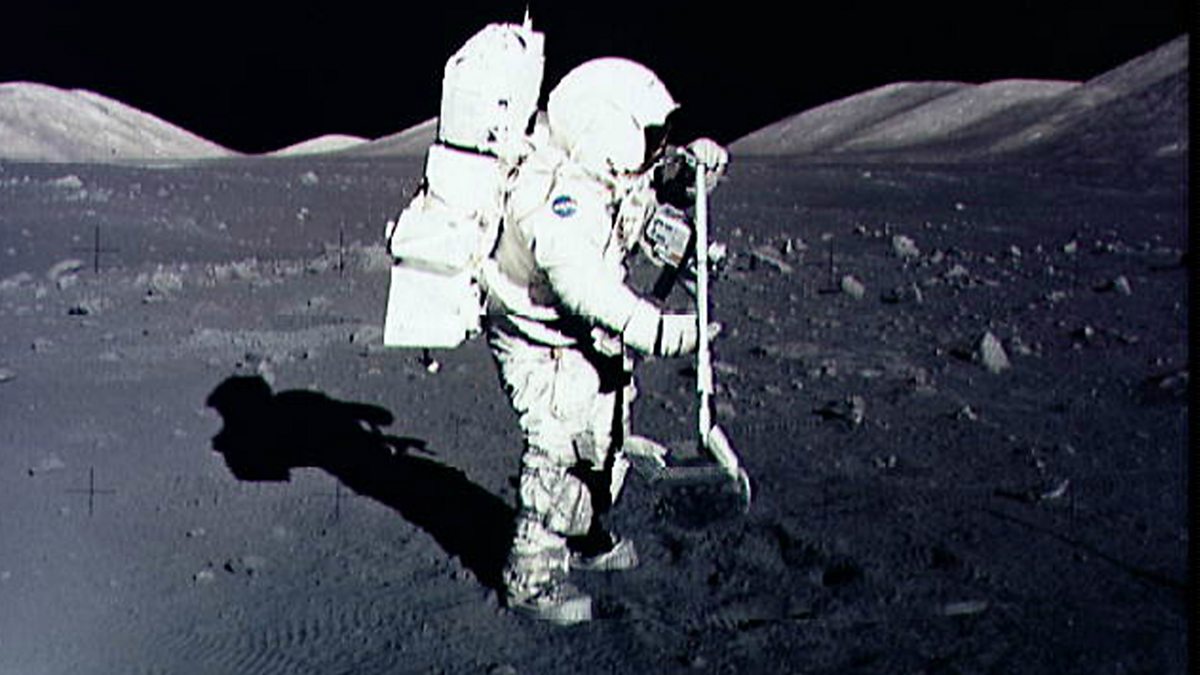
Voyager 1's one-light-day milestone provides an important lesson for future space missions.
As humanity plans to explore more distant planets, moons, and potentially other star systems, communication delays will become an increasingly important challenge.
Space agencies will need spacecraft that can operate independently, solve certain technical problems, and manage their energy supplies without constant instructions from Earth.
The Voyager mission also demonstrates the importance of long-term scientific planning. Its original planetary exploration objectives were completed decades ago, yet the spacecraft continued delivering information about a completely different region of space.
Future missions may build on these lessons by using more advanced instruments, improved power systems, and stronger autonomous technologies.
Although travelling to another star remains far beyond our current capabilities, Voyager 1 has shown that robotic exploration can take humanity into previously unexplored environments.
Final Thoughts
Voyager 1 reaching one light-day from Earth is a historic moment in space exploration. After nearly 49 years of travelling through space, the spacecraft has reached a distance where even a radio signal travelling at the speed of light needs an entire day to reach it.
The milestone highlights the scale of the universe, the challenges of deep-space communication, and the remarkable engineering behind one of NASA's longest-running missions.
Although Voyager 1 is facing power limitations and technical difficulties, its scientific legacy remains extraordinary. From exploring Jupiter and Saturn to entering interstellar space, it has helped scientists understand our cosmic surroundings in ways that were once difficult to imagine.
Most importantly, Voyager 1 carries a message from Earth into the unknown. Its journey reminds us that exploration is not only about reaching a destination but also about asking questions, discovering new possibilities, and continuing to look beyond what we already know.
Voyager 1 reached one light-day from Earth on November 18, 2026.
One light-day is approximately 25.9 billion kilometres.
A radio signal takes approximately 24 hours to travel from Earth to Voyager 1.
Yes, NASA can still detect its carrier signal, although science data transmission has faced technical issues.
It is a gold-plated record containing sounds, music, images, and greetings representing life on Earth.
Sources and notes
Links the author listed for this post.
This article is based on official information and mission updates from NASA and the Jet Propulsion Laboratory (JPL), along with reliable space-science reporting.


Discussion
0 comments
No comments yet
Discussion will appear here once it loads.