Choosing a new doctor can feel overwhelming. You want someone skilled, kind and easy to talk to. That's why many people use online tools like the U.S. News Doctor Finder. But have you ever wondered where those star ratings and review summaries actually come from?
In this guide, I'll explain in plain English how U.S. News builds its doctor profiles, using three main pieces: patient experience ratings, AI-written patient review summaries and areas of expertise. I'll also share simple tips for using these tools wisely. This is based on U.S. News' own Doctor Finder methodology page.
Note: This article explains how a doctor search tool works. It isn't medical advice. Always talk to your own doctor or insurer about your care.
What Is the U.S. News Doctor Finder?
Doctor Finder is a free online search tool from U.S. News & World Report. You can look up doctors by specialty, location, hospital and condition. Each doctor's profile can show things like their specialty, hospital affiliation, years of experience, patient ratings and the conditions they often treat.
The 3 Main Parts of a Doctor Profile
| Part | What it shows | Where the data comes from |
|---|---|---|
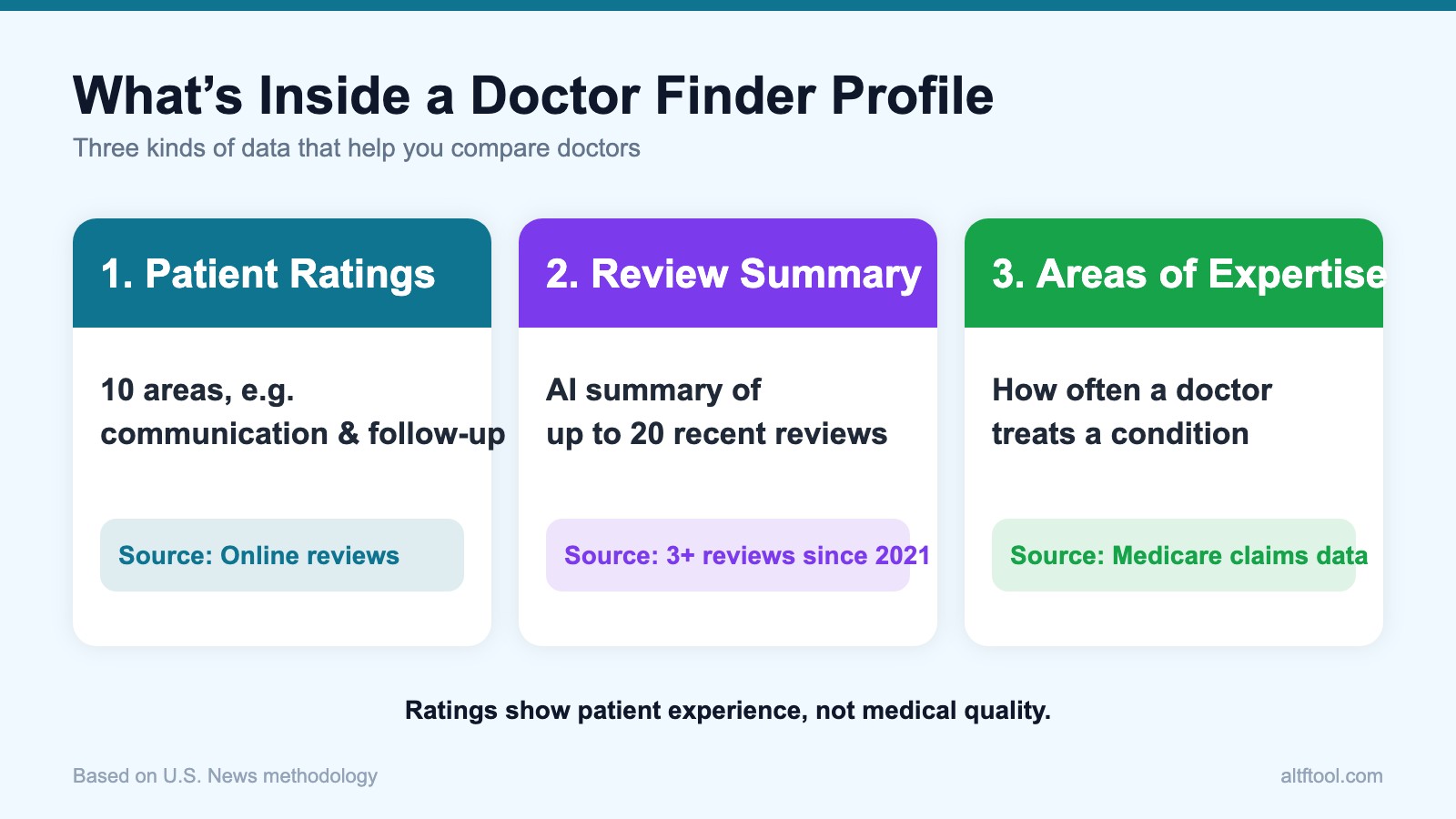
| Patient experience ratings | Star ratings across 10 areas of the patient experience | Online patient reviews from many websites |
| Patient review summary | A short written summary of what patients say | Recent patient reviews, summarized with generative AI |
| Areas of expertise | Conditions and procedures a doctor treats often | Medicare claims data, compared with other doctors |
1. Patient Experience Ratings
U.S. News gathers patient reviews from many places online and turns them into ratings. According to its methodology, the ratings model is based on a 2015 paper in the Patient Experience Journal by researchers from George Washington University's School of Public Health.
The 10 patient experience areas
Doctors can be rated on these 10 topics:
Thoroughness of examination
Ability to answer questions
Clarity of instructions
Provider's follow-up
Amount of time with patient
Provider's attitude
Provider's perceived outcomes
Patient loyalty to provider
Inclusion in decisions
General feedback
Not all review websites count equally
U.S. News gives each review website a "source weight" based on how influential it is with online audiences. So a review from a big, widely used site may count a bit more than one from a small site.
What the ratings do and don't tell you
Here's an important point: U.S. News itself says patient experience ratings may not show who the "best" doctor is. They reflect how patients felt about their visits, like communication and attitude, not medical skill or treatment results. They're most useful when you're choosing between doctors who already seem like a good fit.
What is the "Patient Top Choice" label?
Some profiles show a Patient Top Choice label. U.S. News gives it to doctors who have received a 5-star rating from their patients.
2. AI-Powered Patient Review Summaries
Reading dozens of reviews takes time. So U.S. News uses generative AI to summarize patient reviews into a short paragraph that captures the overall feeling. Here's how it works:
Minimum reviews: A doctor needs at least 3 patient reviews since 2021 to possibly get a summary.
Recent reviews only: If there are many reviews, the summary uses the 20 most recent ones.
Regular updates: Summaries are refreshed from time to time as new reviews come in.
Overall score: The overall rating is an average of the ratings tied to the summarized reviews.
3. Areas of Expertise
This part tells you which conditions or procedures a doctor handles often. U.S. News added this feature in 2023 with health data company CareJourney. It shows how frequently a doctor has treated a condition or done a procedure for Medicare patients, compared with other doctors in their state and across the country.
Why does this matter? Experience counts. If you need a specific procedure, it can be reassuring to choose a doctor who does it regularly.
Keep in mind that this data is based on Medicare patients, who are mostly 65 and older. So it may not fully reflect a doctor's work with younger patients or people with private insurance.
How to Use Doctor Finder the Smart Way
Start with your insurance. Check which doctors are in your network first.
Check areas of expertise. Look for doctors who often treat your condition.
Read the review summary. Get a quick feel for bedside manner and communication.
Look at the number of reviews. A 5-star rating from 50 reviews tells you more than one from 3.
Check credentials. Confirm board certification and hospital affiliation.
Book a first visit. Your own experience matters most.
Limits to Keep in Mind
Ratings are opinions. They show patient satisfaction, not medical quality or outcomes.
Some doctors have few reviews. Small numbers can make ratings less reliable.
AI summaries simplify things. They capture the general mood but can miss details.
Medicare-based data. Expertise data may not cover every type of patient.
Comparing star ratings or review counts between doctors? Our free Percentage Calculator can help you see the difference in seconds.
Frequently asked questions
It combines patient experience ratings from online reviews, AI-written summaries of recent patient reviews, and areas of expertise based on how often a doctor treats certain conditions.
Thoroughness of examination, ability to answer questions, clarity of instructions, follow-up, time with patient, provider's attitude, perceived outcomes, patient loyalty, inclusion in decisions and general feedback.
U.S. News uses generative AI to summarize patient reviews. Doctors need at least 3 reviews since 2021, and the summary uses up to the 20 most recent reviews.
U.S. News gives the Patient Top Choice label to doctors who have received a 5-star rating from their patients.
Not necessarily. Patient experience ratings reflect how patients felt about their visits, not medical quality or outcomes, so use them alongside other information.
Final Thoughts
The U.S. News Doctor Finder brings together three helpful things: what patients say, a quick AI summary of their reviews, and data on how often a doctor treats certain conditions. None of these alone tells you who the perfect doctor is. But used together, and alongside your insurance details and your own first visit, they can make choosing a doctor a lot less stressful.
Sources and notes
Links the author listed for this post.
Rating metrics, source weights, review summary rules, Patient Top Choice label and areas of expertise checked against U.S. News methodology pages and the CareJourney announcement. Not medical advice.
- 1Doctor Finder Data and Methodologies (opens in a new tab)
U.S. News & World Report
- 2U.S. News Patient Reviews Summary (opens in a new tab)
U.S. News & World Report
- 3


Discussion
0 comments