Election Day for the 2026 US midterms was November 3. Weeks later, you might still see headlines saying a few House races haven't been called yet. If that sounds strange, you're not alone. Many people expect every result to be ready on election night.
But here's the truth: in America, election night results are never the final word. Counting every valid vote, checking it and making it official takes time, and that's completely normal. In this guide, I'll explain in simple words why some races take days or even weeks to settle, and what happens along the way.
Note: This article explains how the process works. For the latest race-by-race numbers, check a live results page from a trusted news source or your state's election office, because counts change quickly.
Election Night Results Are Not Final
On election night, the numbers you see on TV are unofficial. They're early counts, reported as election offices work through ballots. In every state, results stay unofficial until they are certified, which happens days or weeks later.
So when a race is "still being counted," it doesn't mean something went wrong. It usually means the gap between candidates is small and there are still valid ballots left to count.
7 Reasons Some House Races Take Longer to Call
1. Mail-in ballots take time to process
Millions of Americans vote by mail. Each envelope has to be opened, the voter's signature checked, and the ballot flattened and scanned. Some states can't even start this work until Election Day, so it piles up.
2. Late-arriving ballots still count in some states
In several states, a mail ballot is valid if it was postmarked by Election Day, even if it arrives a few days later. Officials have to wait for those ballots before they can finish counting.
3. Provisional ballots need to be checked
If there's a question about a voter's registration at the polls, they can cast a provisional ballot. Election staff must confirm the voter was eligible before that vote is counted, and this usually happens in the days after the election.
4. Voters may get a chance to "cure" their ballot
Some states let voters fix small problems, like a missing or mismatched signature, after Election Day. This is called "curing" a ballot, and states give voters a set window to do it.
5. Some states are simply slower by law
Every state sets its own rules. Local deadlines for finishing the count range from the day after the election in Alaska to 30 days afterward in many California elections. That's why California races are often among the last to be called.
6. Very close races can trigger recounts
When the margin is tiny, a recount may be required or requested. A recount checks the accuracy of the first count, and it can push the final result out even further.
7. Ranked-choice voting adds extra rounds
A few places, like Alaska and Maine, use ranked-choice voting. If no candidate gets a majority of first-choice votes, the last-place candidate is removed and their votes move to the voters' next choices. This takes extra time.
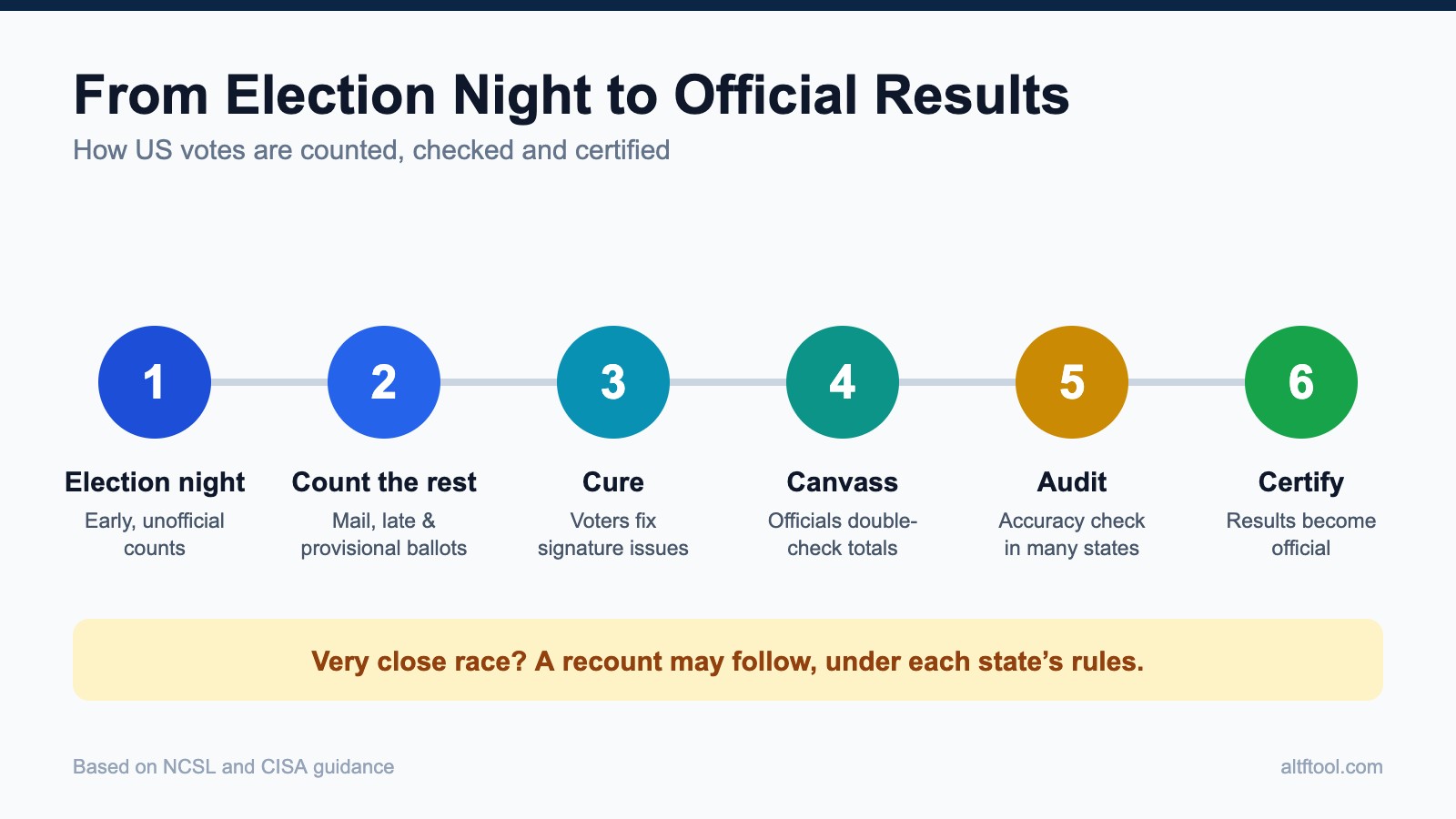
How Vote Counting Works After Election Day
| Step | What happens |
|---|---|
| 1. Election night count | Early, unofficial results are reported as ballots are tallied. |
| 2. Counting remaining ballots | Mail, late-arriving and provisional ballots are processed. |
| 3. Ballot curing | Voters fix signature or other issues, where the state allows. |
| 4. Canvass | Officials double-check every valid ballot and the totals. |
| 5. Audit (in many states) | A check that machines and counts were accurate. |
| 6. Certification | Results become official. |
| 7. Recount (if needed) | A re-check for very close races, under state rules. |
What Does "Calling a Race" Actually Mean?
When you hear that a news organization has "called" a race, it means their election analysts are confident who will win based on the votes counted and the votes still left. Groups like the Associated Press have done this for well over a century.
But a call is not the official result. It's a projection. The official result only comes when state election officials certify the count. If a race is too close for analysts to be confident, they simply wait, sometimes for weeks.
What Is a Canvass?
A canvass is the careful post-election counting and checking of all valid ballots, which leads to the final certified result. Think of it as the "double-check" step between election night and the official numbers.
When Do Results Become Official?
That depends on the state. According to the National Conference of State Legislatures, most states certify results somewhere in the second or third week after Election Day, while some take longer. And in many states, audits must be finished before results can be certified.
After certification, the winners are cleared to take office. New members of the US House are sworn in when the new Congress begins in January.
Why Waiting Is a Good Thing
It can feel frustrating to wait. But slow counting is usually a sign that the system is doing its job: making sure every eligible vote is counted and counted correctly. A fast result is nice, but an accurate result matters more.
How to Follow Close Races the Smart Way
Use trusted sources. Check your state's official election website or well-known news organizations.
Look at "votes counted" estimates. A lead with lots of votes still uncounted can change.
Be careful on social media. Posts claiming a final result before it's official can be wrong or misleading.
Remember time zones. If you're following from abroad, US results often update late at night or early morning in Asia and Europe.
Do the maths yourself. Want to see how big a margin really is? Our free Percentage Calculator turns vote counts into percentages in seconds.
Frequently asked questions
Mail ballots, late-arriving ballots, provisional ballots and ballot curing all take time, and very close races need every valid vote counted before a result is clear.
No. Election night numbers are unofficial. In every state, results only become official after they are certified.
It means its analysts are confident who will win based on votes counted and votes left. It is a projection, not the official certified result.
A canvass is the post-election counting and checking of all valid ballots, which leads to certification of the final results.
It depends on the state. Many states certify in the second or third week after Election Day, while some take longer, and recounts can extend the timeline.
Final Thoughts
So, are the midterms really over on election night? Not quite. A handful of close races can take weeks, thanks to mail ballots, provisional ballots, curing windows, state deadlines and possible recounts. It's not a glitch. It's how American elections are designed: careful, checked and, in the end, certified. Next time you see "still counting," you'll know exactly why.
Sources and notes
Links the author listed for this post.
Explains general US post-election processes. Canvass deadlines, certification timing and audit rules checked against NCSL and CISA guidance. No race results are stated.
- 1After the Voting Ends: Postelection Processes (opens in a new tab)
National Conference of State Legislatures
- 2The Polls Have Closed, What Happens Now? (opens in a new tab)
National Conference of State Legislatures
- 3


Discussion
0 comments